
Hip Joint
Revision Hip & Knee Surgery
Extraction of failed, loose, or infected implants with bone augments, modular stems, and hinged reconstruction.
PJI ProtocolsTrabecular Cones
Explore Technique →Evidence-led joint reconstruction
Comprehensive diagnostic analysis, individualized biomechanical modeling, and advanced arthroplasty techniques curated by UK-trained Consultant Dr. Feras Ya'ish.
Guided Clinical Pathway
Select your anatomical focus and clinical presentation to discover evidence-based intervention pathways and educational procedural briefs.
Step 1: Which joint or clinical concern?
Clinical Notice: This is general educational information. It does not provide medical advice, diagnosis, or candidacy scoring. Only an in-person clinical consultation and radiographic evaluation can determine what is appropriate for you.
Educational guides for the hip, knee, sports, and trauma presentations most often referred to Dr. Ya'ish.
Hip Joint
Osteoarthritis of the hip is progressive cartilage wear of the femoral head and acetabulum. Patients typically describe groin stiffness, night pain, and reduced walking distance. Dr. Ya'ish evaluates constitutional anatomy before recommending joint-preserving care or patient-specific / robotic hip reconstruction.
Knee Joint
Compartmental wear of the knee may affect the medial, lateral, or patellofemoral surfaces. Treatment ranges from activity modification and injections to partial or kinematically aligned total knee replacement, with robotic assistance when precision alignment is required.
Hip Joint
Avascular necrosis (osteonecrosis) interrupts blood supply to the femoral head. Collapse of the head leads to secondary arthritis. Early stages may be observed or decompressed; established collapse is typically treated with total hip reconstruction planned to the patient's anatomy.
Hip Joint
Acetabular dysplasia and femoroacetabular impingement alter load across the hip from a young age. Some patients present with groin stiffness and early arthritis. Reconstruction must restore coverage and offset; replacement, when required, is planned to the patient's anatomy rather than a generic cup position.
Trauma & Other
Pain after hip or knee replacement may come from loosening, osteolysis, instability, fracture, or periprosthetic joint infection. Dr. Ya'ish provides a tertiary revision pathway with metal-reduction CT, aspiration protocols, and modular reconstruction.
Knee Joint
ACL rupture, meniscal tears, ramp lesions, and multi-ligament injury are treated with anatomical arthroscopic reconstruction and repair-first meniscal surgery. The goal is a stable, proprioceptive knee for sport and daily prayer or work demands.
Trauma & Other
High-energy periarticular fractures, open injuries, and established non-unions or malunions require anatomical reduction and stable fixation. Prosthetic dislocation and periprosthetic fractures are managed on a tertiary trauma pathway.
Procedural Directory
Filter by Joint Focus:
Filter by Surgical Intent:
Hip Joint
Extraction of failed, loose, or infected implants with bone augments, modular stems, and hinged reconstruction.
Knee Joint
Complete resurfacing with anatomical kinematic alignment to re-establish natural soft-tissue tension balance.
Knee Joint
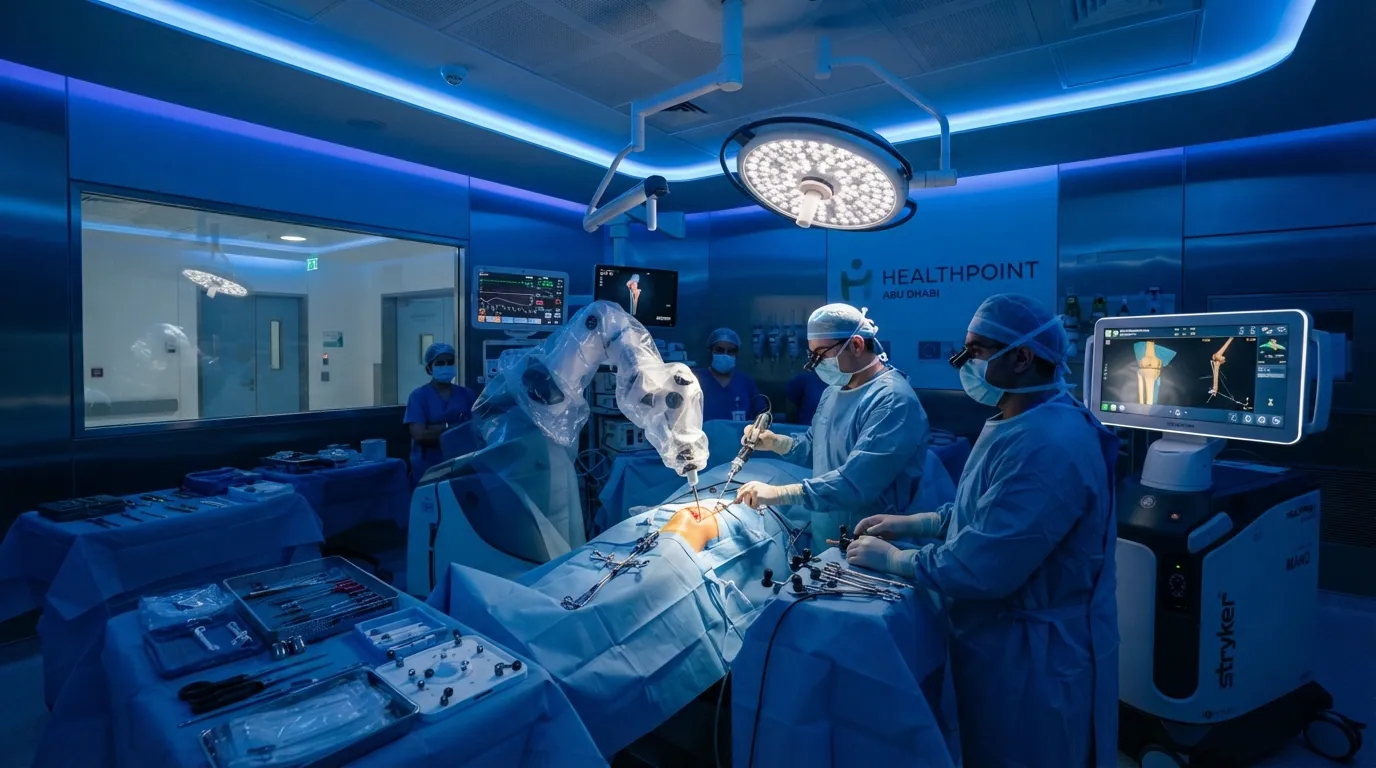
Pre-computed 3D CT surgical modeling paired with intra-operative haptic guidance for sub-millimeter resection accuracy.
Knee Joint
Isolated resurfacing of only the worn compartment, preserving cruciate ligaments and proprioception.
Knee Joint
Anatomical ACL reconstruction and associated ligament repair after knee sports injury.
Knee Joint
Minimally invasive meniscal preservation, cartilage work, and keyhole assessment of the knee.
Trauma & Other
ORIF for complex articular fractures, pelvic trauma stabilization, and surgical revision of non-healing bones.
Objective Surgical Engineering
Orthopaedic surgery utilizes distinct operational methodologies depending on patient-specific bone anatomy, previous surgeries, and biomechanical stability requirements.
| Evaluation Dimension | Robotic-Assisted ArthroplastyHaptic boundary & 3D tracking | Patient-Specific Instrumentation (PSI)Custom 3D-printed cutting jigs | Precision Conventional TechniqueAnatomical intramedullary alignment |
|---|---|---|---|
| What the approach is | A surgeon-controlled robotic arm system that integrates real-time optical tracking arrays to guide bone resection saw blades within strict pre-defined haptic safety envelopes. | Single-use sterile surgical cutting blocks manufactured specifically for the patient's exact bone contours using pre-operative high-resolution imaging. | Standardized modular surgical instrumentation guided by femoral intramedullary rods, extramedullary tibial guides, and mechanical caliper measurements. |
| Pre-operative planning required | Low-dose volumetric CT scan of the hip, knee, and ankle joints converted into an interactive 3D virtual bone model for digital implant pre-sizing. | Comprehensive specialized pre-operative MRI or thin-slice CT scan, requiring 2 to 4 weeks of engineering lead time for additive block manufacturing. | Standard calibrated weight-bearing long-leg radiographs and orthogonal views; digital templating performed directly on calibrated digital X-rays. |
| Surgical execution mechanism | Continuous dynamic intra-operative feedback; tracker pins assess real-time gap balance through the full range of motion before any bone cuts are completed. | Custom polymer jigs are physically keyed directly onto the patient's osteophytes and articular bone surfaces to orient conventional saw blades. | Surgeon assesses soft tissue laxity manually using tensioners and spacer blocks, aligning standard metal cutting blocks with anatomical bony landmarks. |
| Ideal anatomical indications | Complex coronal/sagittal deformities, extra-articular femoral shaft curvature, retained hardware obstructing intramedullary canals, partial knees. | Patients with previous femoral hardware or intramedullary nails where standard rods cannot be safely inserted; predictable anatomy. | Standard severe joint degeneration, severe bone defects where custom jigs cannot seat reliably, or urgent trauma reconstruction settings. |
| Technique Consensus | Technique suitability is evaluated and agreed with the patient during consultation. | Technique suitability is evaluated and agreed with the patient during consultation. | Technique suitability is evaluated and agreed with the patient during consultation. |
Platform and technology availability confirmed at the time of consultation.
Patient Empowerment
Preparing tailored clinical questions in advance ensures you and Dr. Ya'ish thoroughly cover the diagnostic and post-operative aspects most meaningful to your lifestyle.
100% Client-Side Privacy
Zero data tracking, no cookies saved, and no account required. Your selections remain strictly within your local browser.
Assessment
Consultations take place at Healthpoint Hospital, Zayed Sports City, Abu Dhabi. Toll-Free UAE: 800 77.